Origins, Exile, Cryptids, and the Unseen: The Four Questions Behind This Ain't Eden

Some questions do not stay in one category. A story about the beginning of humanity may lead to questions about belonging. A tale of a creature in the wilderness may raise questions about what people believe lies beyond familiar boundaries. And an account of the unseen may invite both careful skepticism and deeper interpretation.
That is the path through This Ain’t Eden: The Wild, the Unseen, and the World Beyond the Garden. Its four themes (Origins, The Exile, Cryptids, and The Unseen) form an interpretive framework, not a set of settled conclusions. The book asks readers to consider how these ideas might connect while keeping evidence, folklore, and metaphysical possibility distinct.
This overview follows the four questions at the heart of that framework: Where did we come from? What does exile mean? What remains at the edge of the known world? And what might exist beyond our senses?
1. Origins: Where did we come from?
“Origins” can mean more than one thing. Science investigates the physical history of human beings through evidence such as fossils, genetics, and archaeology. The Smithsonian’s Human Origins Program describes how these lines of evidence help researchers study human evolution and our species’ history.
A religious text or philosophical reading may ask a different kind of question: What does a creation story say about human nature, our relationship with the world, or the feeling that we belong somewhere beyond our present circumstances?
Those approaches are not interchangeable. A metaphysical interpretation cannot replace scientific evidence, and scientific research does not settle every question of spiritual meaning. Trouble begins when we present one kind of claim as though it answered all the others.
In This Ain’t Eden, the question of origins opens a speculative reading of Eden and humanity’s beginnings. It asks whether the garden might be understood as more than a location on an earthly map. That is a metaphysical hypothesis, not an established scientific finding. Readers can explore what the idea suggests without mistaking it for proof that humans came from another realm or planet.
This distinction is useful in philosophical perspectives and deep reading analysis: What does a passage say? What evidence supports a factual claim? What is an interpretation adding? Asking those questions can make a difficult text more engaging, not less.
2. The Exile: What does it mean to be cast out?
In the familiar reading of Genesis, exile means leaving the Garden of Eden. But exile can also carry a wider meaning: separation from safety, abundance, home, or a sense of closeness to the divine.
That broader meaning is not necessarily a claim about a physical journey between worlds. It is one way to interpret a story about loss and change. Read this way, exile describes a shift in human experience: from belonging to alienation, from ease to struggle, or from a protected place into a world that must be navigated.

The idea connects with a question many people recognize even outside religious reading: Why can the world feel like home and yet leave us feeling out of place? The story of exile gives that feeling a narrative form. It does not prove that humanity once lived in a separate realm; it offers a frame through which to consider belonging and loss.
The earlier essay “What If Eden Was Never on This Earth? Rethinking Cryptids, Exile, and the Origin of Man” develops this possibility in greater detail. It keeps the proposal in the realm of interpretation rather than presenting it as science.
That boundary matters. Good interpretive writing can entertain a possibility while being honest about what it cannot establish.
3. Cryptids: What remains at the edge of the known world?
Cryptids are creatures reported in stories or encounters but not scientifically verified as species. Bigfoot, Mothman, and lake monsters are among the best-known examples. Their stories come from different places and traditions, so they should not all be treated as the same kind of claim.
Here, the lanes matter. Science asks whether evidence supports the existence of a creature as a biological species. Folklore examines how stories form, change, and carry meaning within communities. Metaphysical interpretation may ask what a creature represents in a broader view of reality. One lane does not prove the conclusions of another.
The presence of a story, a sincere witness, or an unexplained image does not by itself establish a new animal. A witness can be honest and mistaken. A photograph can be ambiguous. A tradition can be culturally important without functioning as a zoological record.
Folklore scholarship can still help explain why such accounts matter. David J. Puglia’s article, “The (Mostly) Unseen World of Cryptids,” examines legendary monsters as cultural narratives, including how they can express community concerns and ideas about place. Studying a story’s significance does not require accepting its creature as biologically real.

This is the subject of “Bigfoot, Mothman, and the Edge of the Map: Why Some Creatures Refuse to Be Classified.” Cryptid stories often gather around wilderness and uncertainty. The places where familiar categories feel less secure. That makes them rich subjects for thought-provoking essays, but their cultural power should not be confused with proof of a creature’s existence.
The book’s broader metaphysical hypothesis asks whether these figures might connect, symbolically or otherwise, to the idea of a world beyond the garden. It does not establish that cryptids are survivors from Eden or beings from another dimension. The reader is invited to weigh the question, not inherit a verdict.
4. The Unseen: What may lie beyond our senses?
We do not experience the world through unlimited senses. There are things we cannot see, hear, or detect without instruments. Science extends observation through tools and testable methods. But the existence of limits to perception does not, on its own, prove any particular supernatural explanation.
“The Unseen” in This Ain’t Eden opens a more speculative question: Could reality include dimensions of existence that ordinary perception does not reveal? This is a metaphysical possibility considered by the book, not an established scientific result. Claims about angels, demons, portals, or other realms should not be presented as empirically verified simply because they are difficult to disprove.
A careful reader can hold two thoughts together: human perception is limited, and a claim about what lies beyond it still needs to be weighed on its own terms. “We cannot rule it out” is not the same as “we have shown it to be true.”
That kind of distinction belongs in critical thinking essays and educational research articles, and it has relevance for perspectives on education: readers benefit from learning how to separate observation, evidence, interpretation, and belief. Open-minded inquiry is not a refusal to judge. It is a willingness to examine a claim before deciding what the evidence allows us to say.
A framework to consider, not a conclusion to adopt
The four questions connect, but they do not collapse into one answer. Origins concerns beginnings. The Exile explores separation and belonging. Cryptids bring us to the border between reported experience and verified evidence. The Unseen considers the limits of perception and the possibility of realities beyond it.
Together, they create a route through the book’s ideas. A prompt for independent thinking rather than a demand for agreement. Readers drawn to open minded books, independent thinking books, or open minded literature may find the questions worth exploring precisely because the answers are not presented as settled fact. The aim is to invite serious consideration while keeping uncertainty visible.
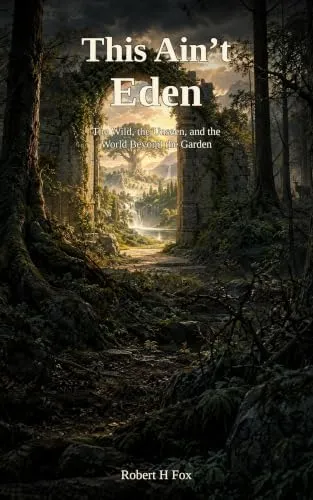
This Ain’t Eden: The Wild, the Unseen, and the World Beyond the Garden by Robert H. Fox was published October 3, 2026. The 144-page book is available in ebook and paperback editions. It brings biblical reading, folklore, scientific knowledge, and a clearly identified metaphysical hypothesis into conversation without treating them as the same kind of evidence. Explore the book on Amazon.
You do not have to accept its hypothesis to consider its questions. Read closely. Notice where evidence ends and interpretation begins. Take folklore seriously without treating it as scientific confirmation. Stay open to possibilities without letting possibility become certainty.
That is disciplined curiosity: open-minded, but not credulous.