Last Updated: October 26, 2026
Quick Summary
Academic rigor in amateur historical research is the discipline of testing your own conclusions as hard as you test everyone else's, following a repeatable method and weighing sources by reliability. It means stating clearly what the evidence supports and what it does not, and judging research by its process rather than its author's credentials.
- Use the same seven-step source evaluation checklist on every source, every time.
- Score each source as strong, weak, or unknown to record what you actually know.
- Keep a source log with one row per item from day one of your research.
- Trust a claim more when a primary and an independent secondary source agree.
- State your confidence, name the gaps, and keep competing explanations alive.
Table of Contents
- What Academic Rigor Means for the Amateur Historian
- Historical Research Source Evaluation: A Repeatable Checklist
- Primary and Secondary Sources in History: How to Weigh Each One
- Historical Research Citation Practices and Archival Documentation
- The Limitations of Historical Research and How to Handle Uncertainty
- Putting Academic Rigor to Work in Your Own Investigation
- Frequently Asked Questions
What Academic Rigor Means for the Amateur Historian
Academic rigor in amateur historical research is the discipline of testing your own conclusions as hard as you test everyone else's.
Most people assume rigor belongs to universities and credentials to historians. At Robert H Fox, we take a different view: rigor is a set of habits anyone can learn, and the best independent researchers practice it without a single academic title.
The payoff is simple. Rigorous work survives scrutiny. Loose work collapses the moment someone asks a fair question.
The Difference Between Rigor and Credentials
Credentials prove you finished a program. Rigor proves you can defend a claim.
Plenty of credentialed work is sloppy, and plenty of independent work is careful.
A common mistake is treating a famous name as proof. A claim is only as strong as the evidence behind it, whoever signs it.
Judge research by its process, not its author. Ask three questions:
- Can I see where each claim came from?
- Did the writer weigh sources against each other?
- Does the conclusion admit what remains uncertain?
If the answer is yes to all three, you are reading rigorous work. Credentials are a bonus, never a substitute.
Historical Research Source Evaluation: A Repeatable Checklist
Use the same evaluation steps on every source, every time. A fixed checklist turns good intentions into a real method and is the single biggest upgrade an independent researcher can make.
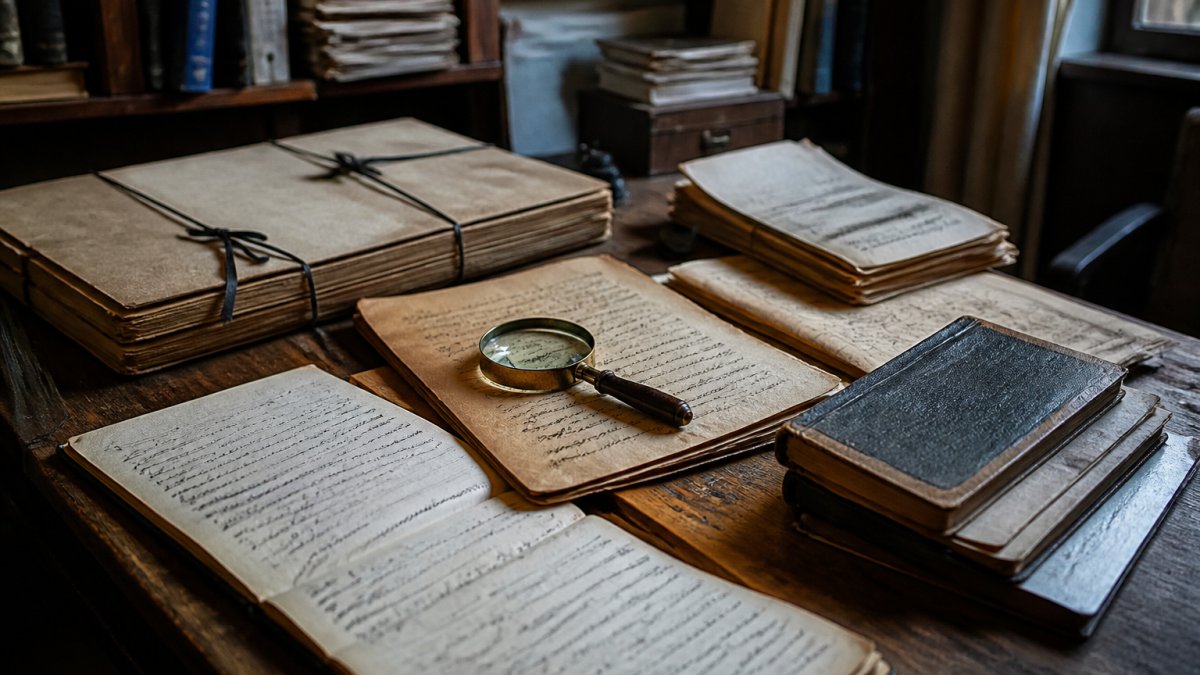
Run each source through these steps, scoring each as strong, weak, or unknown. The score records what you actually know about the source, not a grade for it.
- Identify the author. Who made this, and what did they stand to gain? A land deed signed by a surveyor who owned neighboring plots deserves a second look. If the author is anonymous, note that as a limitation, not a disqualifier.
- Trace the provenance. Where has this document or object been, and who handled it? A letter donated by the family that received it carries a clearer chain of custody than one bought at an estate sale with no paperwork. Ask the archive for its accession record when possible.
- Date it. When was it made, and is that date itself reliable? A diary entry dated 1864 but written in a modern hand is a red flag. Cross-check dates against paper type, ink, handwriting style, and internal references to known events.
- Check the context. What was happening around it that shaped its content? A newspaper account of a labor strike written by a paper owned by the mill owner is still evidence, but of the owner's perspective as much as of the strike.
- Look for bias. What does the author leave out or push hard? Bias is not a reason to discard a source. Every source has an angle; name it and account for it in your notes.
- Corroborate. Does an independent source say the same thing? Two letters from the same family are not two independent witnesses. Look for a record created by someone with no connection to the first source.
- Note the limits. What can this source not tell you? A tax record can confirm that a person owned property in a given year; it cannot tell you how they felt about it. Write down the boundary explicitly.
A source that scores weak or unknown on two or three steps can still be useful, but only if you say so in your notes. The danger is not using a flawed source; it is using one without acknowledging its flaws.
Provenance, Bias, and Context in Practice
Provenance is the record of a source's ownership and path to you.
Bias is not a reason to discard a source; every source has an angle, and the job is to name it and account for it.
Context does the rest. The US National Archives guide to evaluating sources walks through these questions in more depth and is worth keeping open while you work.
Primary and Secondary Sources in History: How to Weigh Each One
Primary sources are the raw material: letters, diaries, court records, artifacts, photographs, and witness testimony created at the time.
Neither type wins by default. A primary source can be forged, misread, or written by someone with an agenda.
Here is how we weigh them:
| Source type | Strength | Weakness | How to use it |
|---|---|---|---|
| Primary | Direct evidence | Can be biased or incomplete | Corroborate before relying on it |
| Secondary | Adds analysis and context | One step removed from events | Check what it cites |
| Tertiary | Fast overview | Repeats errors | Use only as a starting point |
The rule we follow: trust a claim more when a primary source and an independent secondary source agree. When they clash, the clash itself is the story.
Historical Research Citation Practices and Archival Documentation
Good citation practices in historical research mean recording exactly where every claim came from, in enough detail that another person could find the same material.
Document as you go, not afterward: memory invents details, and a missing call number can cost you a return trip.
For each item, record:
- Archive or collection name
- Box, folder, and item number
- Page or folio reference
For online material, save the link and a dated copy. The Library of Congress research and citation guidance offers a solid model for structuring archival references.
What a Usable Archival Reference Looks Like
A citation is usable when a stranger could follow it. Compare these two notes on the same letter:
- Weak: "Letter from J. Smith, 1863, in the archive."
- Strong: "John Smith to Mary Smith, 14 March 1863, Smith Family Papers, 1850-1900, Box 2, Folder 7, Item 3, [Archive Name], [City]. Accessed 12 May 2026."
The strong version names the creator, recipient, date, collection, box and folder, item, repository, and access date, the detail that makes a claim verifiable.
For published secondary sources, a consistent footnote style is enough: the same fields in the same order every time, not a perfect style guide. Most word processors and reference managers can generate footnotes and bibliographies from a structured source list, which is why the source log matters.
Documenting Digital and Online Sources
Digital sources need the same discipline as paper ones, plus a few extra habits:
- Save a dated copy. Use your browser's print-to-PDF or a screenshot tool, and name the file with the date. A link alone is not a citation.
- Record the metadata. Note the site name, the page title, the author if listed, the publication or last-updated date, and the URL.
- Check transcriptions against the image. Many digitized archives provide both a page image and a transcription. When possible, read the image; transcriptions contain errors.
A simple numbered system beats a perfect one you never use. Consistency makes a bibliography trustworthy, and a trustworthy bibliography lets a reader check your work.
The Limitations of Historical Research and How to Handle Uncertainty
The limitations of historical research are real and permanent. Evidence is fragmentary. Records were kept for someone's purpose, not yours. Much of what happened left no trace at all.
That is not a reason to give up, but a reason to qualify your conclusions.
Handle uncertainty in three ways:
- State your confidence. Say "the evidence suggests" when it does, and "this is certain" only when it is.
- Name the gaps. Negative evidence, the record that should exist but does not, often tells you as much as what survives.
- Keep competing explanations alive. If two readings fit the evidence, present both.
Watch out: the most common failure is smoothing over gaps to make a clean story. The American Historical Association's statement on standards of professional conduct makes the same point about honesty in historical claims.
Putting Academic Rigor to Work in Your Own Investigation
Rigor becomes real when you apply it to a single question, start to finish. Here is the workflow we would use for any independent investigation.
- Frame one answerable question. Narrow it until evidence could settle it.
- Map what already exists. Read secondary sources to learn the debate.
- Gather primary material. Log every item with full documentation.
- Evaluate each source with the checklist above.
- Corroborate across independent sources.
- Write your claim and its limits. Say what you can prove and what you cannot.
- Invite challenge. Show your work to a skeptical reader.
That last step is quality control outside academia. A sharp friend who wants to disprove you is worth more than a sympathetic one.
This is the method behind Robert H Fox's work, including This Ain't Eden and the fiction of From Shadows To Light.
Frequently Asked Questions
Can a person be a historian without a degree?
Yes. A degree is not what makes someone a historian; the method is. An independent historian who documents sources, evaluates provenance, separates primary from secondary evidence, and qualifies conclusions is practicing history. Academic credentials and institutional affiliation help with access to archives and peer review, but they do not replace source criticism and corroboration. What separates a rigorous amateur from a speculator is whether claims can be traced back to verifiable evidence and whether conflicting sources are addressed rather than ignored.
How can amateur historians assess whether a historical source is reliable?
Start with provenance: who created the source, when, and for what purpose. Then check bias and context, asking what the author stood to gain or lose. Corroborate the claim against at least two independent sources, and note whether those sources share an origin. A repeatable checklist covering provenance, bias, context, corroboration, and source limitations will catch most weak evidence before it reaches your conclusions. Document each step so another researcher could repeat your evaluation.
How should independent researchers document and cite historical evidence?
Record the archive or repository, collection name, box and folder, item description, and date for every document you use. For published works, capture author, title, publisher, year, and page numbers. Keep a research log noting where you searched and what you failed to find, since negative evidence matters. Consistent historical research citation practices let readers verify your claims and let you revisit your own work months later without guessing which folder a quotation came from.
What are the limitations of historical research?
The record is incomplete, and what survives was often preserved by people with power or an agenda. Witness testimony drifts with memory, archives have gaps, and dating methods carry margins of error. These limitations of historical research do not make rigor impossible; they make qualified conclusions necessary. State what the evidence supports, name what it cannot settle, and treat conflicting or negative evidence as data rather than inconvenience. Speculation becomes defensible when it is labeled as interpretation and tied to documented sources.
The hard part is not finding material. It is staying honest when a story would be more satisfying than the evidence allows. Robert H Fox builds every book on that discipline, from the interpretive journey in This Ain't Eden to the annotated research behind it, so readers can check the work themselves. Get started with Robert H Fox and explore the mysteries with rigor you can verify.